
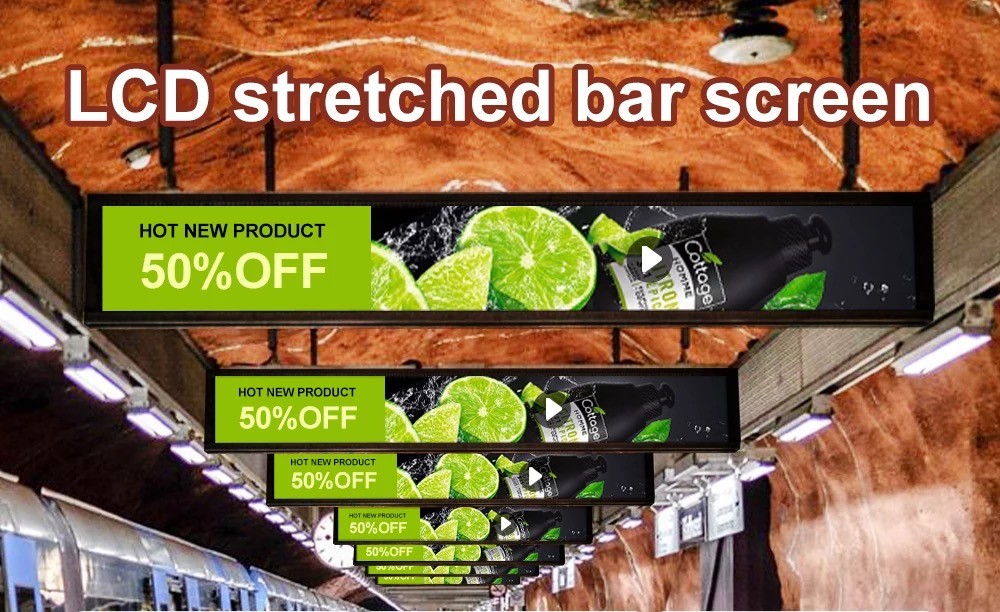
If you’ve ever taken the metro, you’ve seen them: the long, narrow LCD screens above doors or along station platforms — showing current route, next station, first/last train times, exit directions, and real-time alerts.
But here’s what most passengers don’t realize: these screens operate in one of the harshest environments for any electronic device. Metro trains vibrate constantly, temperatures fluctuate, dust and humidity are everywhere, and power supply is unstable. A failed screen mid-route isn’t just an inconvenience — it’s a safety & operational issue.
So what makes a stretched bar LCD display “metro-grade”? Based on real deployment requirements, here are 5 engineering features that actually matter — with specifications.
1. Anti-Shake, Dust-Proof & Explosion-Proof
Metro trains generate constant low-frequency vibration + high-impact shocks from braking or rail joints. Standard commercial displays aren’t built for this.
• Anti-shake: Reinforced brackets + shock-absorbing mounts secure internal components.
• Dust-proof: Sealed enclosure (IP5X or higher) prevents fine particles from entering.
• Explosion-proof front panel: Tempered glass or impact-resistant polycarbonate.
Why it matters: Without these, a standard screen might last 6–12 months in a metro environment. A properly engineered display is designed for 5+ years.
2. Fanless Cooling for High-Density Enclosures
Metro guide screens are often mounted inside train ceiling cavities or slim station pillars — zero room for fans. Even with space, fans would suck in dust and fail rapidly.
| Feature | Engineering solution | Benefit |
|---|---|---|
| Cooling method | Passive cooling (aluminum heat sinks + thermal conduction) | No moving parts → higher MTBF |
| Operating temperature | 0℃ ~ 45℃ | Reliable in metro car climate (winter / summer) |
| Operating humidity | 10% ~ 85% (non-condensing) | Works in humid tunnels & underground stations |
| Enclosure design | Fully sealed, no air intake | Zero dust accumulation, maintenance-free |
Real-world context: A fanless system runs silent, consumes less power, and removes one major failure point. For metro applications where MTBF is critical, every moving part eliminated increases reliability.
3. Reliability: 50,000 Hours MTBF
This is the single most important specification for any industrial display — the statistical backbone of long-term operation.
• Statistically, the average time between failures is 50,000 hours.
• For a metro screen running 18–20 hours/day, that’s approximately 7–8 years of expected reliable operation.
• Achieved via: conformal coating (PCB protection), reinforced soldering, vibration-resistant connectors, and burn-in testing.
| Metric | Standard Commercial Display | Metro-Grade Stretched Bar Display |
|---|---|---|
| MTBF | 10,000 – 20,000 hours | 50,000 hours |
| Expected lifespan (metro environment) | 1–2 years | 5–8 years |
| Annual failure rate (est.) | ~10–15% | ~2–3% |
Why it matters for operators: For a metro system running 1,000 screens, a 2% vs. 12% annual failure rate means 100 fewer failures per year — massive savings in maintenance labor and service disruptions.
4. Power Adaptability: Wide Voltage Tolerance
Metro trains do not have stable power. Starting, accelerating, or braking can cause severe voltage spikes or drops. Standard electronics would reset — or fry.
Protection: Over-voltage, under-voltage, over-current, reverse polarity.
| Voltage Condition | Display Response |
|---|---|
| Normal (24V nominal) | Normal operation |
| Drop to 9V (startup / heavy acceleration) | Continues operating — no reset, no flicker |
| Spike to 36V (regenerative braking) | Protected circuitry prevents damage |
| Polarity reversed (installation error) | No damage — protection block |
Why this matters: A metro display that resets every time the train starts is useless. Wide voltage tolerance ensures the screen stays on, showing real-time information continuously, regardless of power fluctuations.
5. Differential Signal Transmission for Long-Distance, Noisy Environments
Metro trains generate massive electromagnetic interference (EMI): motors, brakes, HVAC, wireless communications. Standard video cables (HDMI, VGA) lose signal quality after just a few meters in this environment.
LVDS or similar technology — transmits signal as complementary voltage pairs, canceling out interference.
Boosts signal strength for long cable runs (10–15 meters).
Additional EMI protection for metro-grade reliability.
What this delivers: Clean audio and video over 10–15 meter distances without attenuation — no flickering, no artifacts, no dropouts, even when the train is running at full speed.
Real-world application: In a metro car, the media player is often in a sealed equipment cabinet at one end, while the display is mounted near doors 8 meters away. Differential signaling ensures perfect image quality at both ends.
Summary: What Makes a Metro-Grade Display?
| Feature | Specification / Implementation | Operational Benefit |
|---|---|---|
| Anti-shake / dust / impact | Reinforced chassis, sealed IP enclosure (IP5X+), tempered glass | Survives vibration, dust, and physical impact |
| Cooling | Fanless, passive (heat sink) | Silent, dust-free, one less failure point |
| Reliability (MTBF) | 50,000 hours | 7–8 years expected operation |
| Power adaptability | DC 9V–36V + full protection | Works through train voltage fluctuations |
| Signal transmission | Differential signaling (LVDS) + relay amplifier | Clean A/V over 10–15m in high-EMI environment |
| Operating temperature | 0℃ ~ 45℃ | Reliable in all metro climate conditions |
| Operating humidity | 10% ~ 85% | Works in humid underground stations & tunnels |
Buyer’s Quick Checklist
When evaluating stretched bar LCD displays for metro applications, ask your vendor these 5 questions:
- ☐ What is the MTBF? (If they don’t have a number, walk away.)
- ☐ What’s the input voltage range? (DC 9–36V minimum for metro.)
- ☐ Is cooling fanless? (If it has a fan, ask about dust maintenance & lifespan.)
- ☐ What signal transmission distance is supported? (10+ meters needed for most metro cars.)
- ☐ Has this model been deployed in any metro project? (Ask for references or case studies.)
≈ 7–8 years at 18h/day
Survives startup dips & braking spikes
All-season metro operation


Leave A Comment