
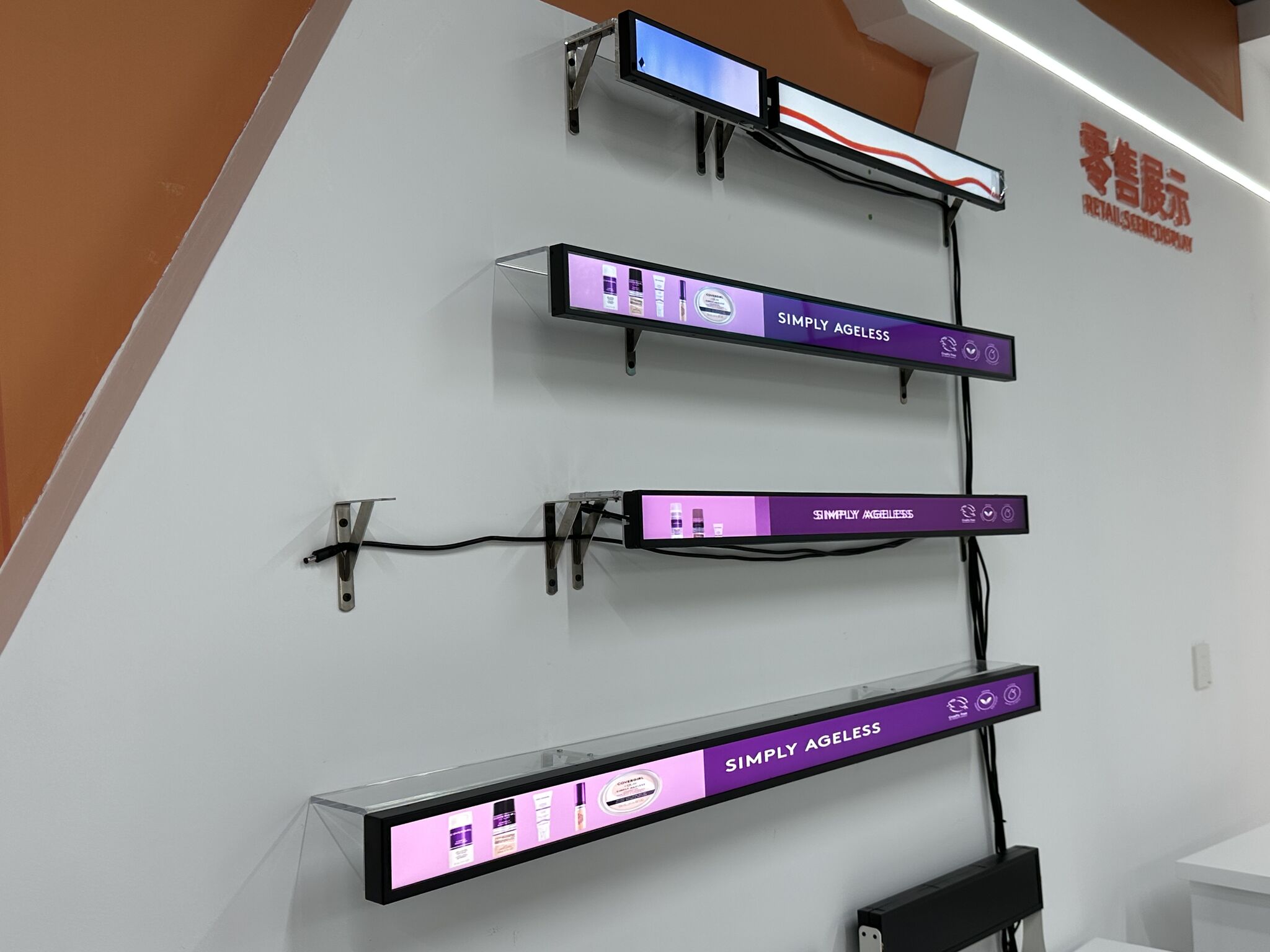
In convenience stores, where space is limited and impulse purchases account for a significant share of sales, digital shelf edge LCD displays (SELDs) are attracting increasing attention from operators. These small screens can turn idle shelf edges into information display points for targeted ads, real-time promotions, or customer guidance to online interactions. However, the actual effectiveness and cost-benefit ratio vary significantly depending on store size, customer demographics, and execution quality. This article aims to provide an objective analysis of the applicability, potential benefits, and key challenges of SELDs in convenience store settings.
# 1. Why Consider SELDs in Convenience Stores?
Traditional paper labels or static signs have limitations in update speed, visual appeal, and interactivity. The advantages of SELDs include:
Space utilization : Screens of 7–10 inches can be installed on shelf edges to display prices, promotions, or QR codes.
Real-time updates : Prices and promotions can be adjusted remotely, which is especially useful for fresh foods and short-shelf-life items that require frequent price changes.
Triggering impulse purchases : Dynamic images attract attention more effectively than static labels. According to field test data from industry research firms (e.g., PG Ventures, 2022), dynamic electronic screens have an attention rate roughly 30% higher than paper labels for certain categories. However, the actual impact on sales is influenced by many factors and is not guaranteed.
# 2. Case Study: 7-Eleven’s Digital Transformation
The original article mentioned that 7-Eleven deployed SELDs across 1,000 stores in 2023 and observed an 8% increase in same-store sales. The following context is necessary:
7-Eleven’s digital transformation was a comprehensive initiative that included loyalty program upgrades, proprietary delivery system optimizations, store lighting and layout renovations, and more. Attributing the full 8% growth solely to SELDs is an oversimplification.
According to 7-Eleven’s annual report (2023), the primary role of its digital screens was to improve promotional update efficiency and brand partner displays, rather than directly driving sales. In actual A/B tests, sales lifts for shelf categories with dynamic screens (e.g., beverages, snacks) ranged from 3% to 9%, with weaker effects on higher-priced items.
Small and medium-sized convenience stores do not have the same technical teams or supply chain integration capabilities and should not benchmark directly against 7-Eleven.
# 3. Content Design: Effective Communication in a Short Time
In narrow aisle environments, customer dwell time is often less than 10 seconds. Therefore, SELD content should follow the principles of “minimal, frequent, actionable”:
Short copy : e.g., “Latte 30% less sugar,” “Last 10 minutes: buy one get one half off.”
Simple interaction : QR codes can link to loyalty mini-programs or coupons, but the scan path should be no more than two steps.
Localized content : e.g., “Try our locally baked XX bread.”
An internal test by a UK regional convenience store chain (2023) rotated ads every 15 seconds and observed a roughly 15% increase in cross-purchase of high-margin snacks. However, this test was based on a single region over only four weeks, and long-term results have not been verified.
# 4. Realistic Revenue Models and Cost Structure
## Potential Revenue Sources
| Model | Description | Real-World Market Reference (U.S. C-stores) |
| Brand endcap ads | Suppliers pay for display space | $50–$150 per store per month (not $200–$500) |
| Dynamic pricing promotions | Adjust prices based on time of day or inventory | Limited-time discounts during peak hours; median lift in tests around 5% |
| Data insights services | Aggregate anonymized sales timing data for suppliers | Requires compliance; most small suppliers are unwilling to pay |
## Commonly Overlooked Costs
Hardware : Durable SELD units cost approx. $150–$300 each (dust-resistant, wide-temperature operation).
Installation & wiring : Shelf modifications and power cabling average $50–$100 per screen.
Software & maintenance : Content management system (CMS) subscription fees, repairs, cleaning, and screen protection. Annual operating costs are roughly 30%–50% of hardware investment.
Payback period estimate : For stores with <300 daily visitors and no brand subsidies, payback typically exceeds 18 months.
# 5. Key Challenges and Risks of Failure
- Customer acceptance: Some older customers may resist screen flicker or QR code scanning. Multiple screens changing simultaneously in narrow aisles can cause visual distraction.
- Technical reliability: Screen failures, network outages, or failed content updates can lead to incorrect pricing information and customer complaints.
- Data compliance: Collecting scan or interaction data requires informed user consent and compliance with GDPR, CCPA, or local privacy laws. Selling “peak buying time data” requires anonymization to the level where individual stores and customers cannot be identified.
- Alternative solutions: Electronic shelf labels (EPD) are more energy-efficient and easier to read; paper “shelf talkers” have extremely low cost. SELDs are not the optimal solution in every scenario.
# 6. Conclusion: Worth Trying, but With Realistic Expectations
SELDs are not a magic solution, but they can offer value in certain convenience store scenarios—especially those with high foot traffic, many short-shelf-life items, and access to brand partner funding. The key is to:
Start with small-scale tests : Deploy on 2–3 shelves first (e.g., beverages, ready-to-eat foods) and compare sales and customer feedback.
Define clear ROI metrics : Look beyond sales to include labor hours saved on promotional updates, supplier advertising revenue, QR code interaction rates, and other indicators.
Accept technical limitations : Screens are tools. Ultimately, results still depend on product quality, pricing, and service.
As hardware costs decline and content management platforms become lighter and simpler, SELDs may evolve from a novelty into a practical tool. However, for now, convenience store operators should avoid being driven by marketing hype and make decisions based on their own foot traffic, customer profiles, and financial capacity.


Leave A Comment